How to Study for Internals Using Your Notes and Syllabus
Internal exams reward focused preparation. If you already have class notes and even a rough syllabus, you do not need a huge study plan. You need a reliable way to identify what matters first, where questions are likely to come from, and which topics need practice instead of passive reading.

Key takeaways
- Start with notes that reflect what was actually taught in class.
- Map each unit to likely marks-based question patterns before revising deeply.
- Use a question bank only after you know which parts of the syllabus are most likely to show up.
Start with the notes your faculty actually used
The best internal exam preparation usually starts from lecture notes, faculty slides, and unit summaries instead of generic internet material. Internal papers often follow classroom emphasis more closely than final exams do.
Combine all your notes into one clean revision stack. Remove duplicate pages, highlight repeated keywords, and mark any topic your teacher spent extra time on.
- Circle definitions, formulas, and processes that appeared more than once in class.
- Mark units where your notes are incomplete so you can patch them first.
- Separate theory-heavy topics from problem-solving topics before revision begins.
Use the syllabus to narrow your internal exam revision
A syllabus is not just a list of units. For internal exams, it acts like a scope filter. When you align notes to the syllabus, you reduce wasted revision and avoid preparing from chapters that are unlikely to be tested now.
If you only have a partial syllabus, that is still useful. Even a unit list helps you identify coverage gaps and predict which sections are too large to ignore.
- Map every note page to a unit or sub-topic.
- Rank each unit as high, medium, or low revision priority.
- Note likely short-answer, 5-mark, and 10-mark topics separately.
Turn revision into predicted-question practice
Once your notes and syllabus are aligned, the next step is not reading again. It is practicing targeted questions. A good internal exam question bank should reflect your own notes, the teaching pattern, and the likely marks distribution.
This is where a prediction workflow becomes useful. Instead of guessing alone, you can use your material to generate a narrower list of practice questions and revise around them with confidence.
- Practice one short-answer block and one long-answer block from every priority unit.
- Review answers against your own note language so you stay aligned with class terminology.
- Revisit only missed concepts, not the whole unit, after each practice round.
Frequently asked questions
How many days before internals should I start revising?
Even three to five days can be enough if your notes are organized and the syllabus scope is clear. The key is to prioritize likely-question zones instead of reading every page equally.
Can I study for internals using only class notes?
Yes, in many cases class notes are the strongest starting point because internal exams often reflect what was emphasized in class. You only need extra material where your notes are incomplete.
Want Eleventh Hour to build a prediction report from your notes?
Join the beta waitlist to get early access to note-based exam prediction, detailed revision reports, and targeted question banks built for university students.
Join the beta waitlistRelated articles
Keep building your exam preparation system with these next reads.

How to Prepare for Sem End Exams with a Question Bank
Sem end exams feel bigger because they cover more, but a well-structured question bank can turn full-sem chaos into a revision plan you can actually finish.
Read article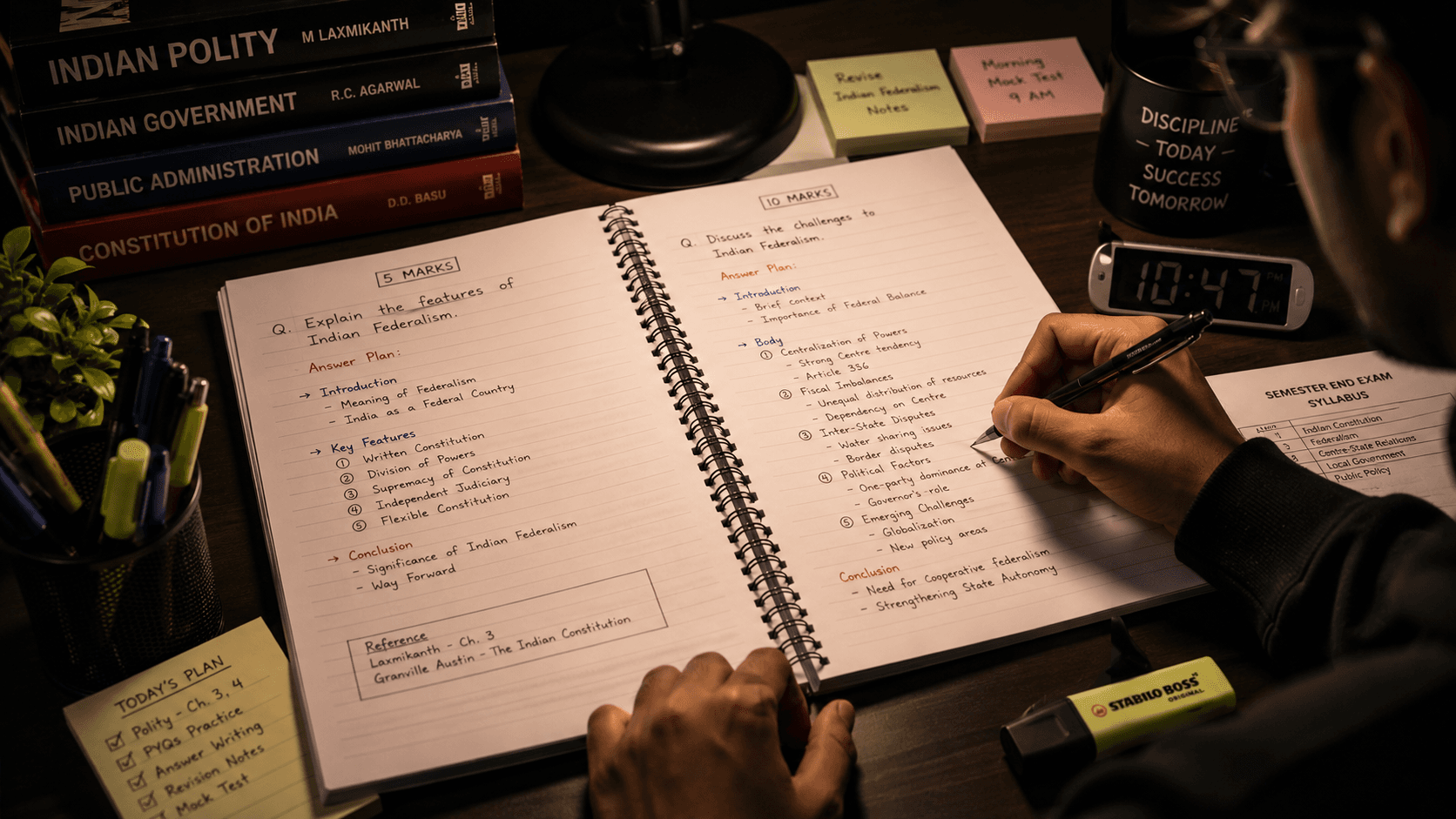
5-Mark vs 10-Mark Questions: How University Students Should Prepare
If you answer 5-mark and 10-mark questions with the same preparation style, you usually lose marks. The answer depth is different, and your revision should reflect that.
Read article
How to Find Important Questions from Class Notes
The easiest way to find important questions is to read your notes for signals, not just information. Repetition, emphasis, and structure usually tell you where marks come from.
Read article