How to Turn Lecture Notes into a Practice Question Bank
Lecture notes are not just revision material. They are source material for predicted questions. When you convert headings, keywords, examples, and repeated explanations into question formats, you create a practice bank that matches your actual course better than generic collections do.

Key takeaways
- Question banks become more useful when they are built from your own notes.
- Different question patterns should come from the same topic in different answer depths.
- A good bank is short enough to finish and broad enough to cover likely units.
Break notes into question-worthy units
Every topic in your notes should be rewritten as a question before it becomes revision-ready. Definitions, diagrams, lists, processes, comparisons, and cases all translate differently into exam prompts.
This step prevents passive rereading because it forces you to think like the paper setter, not just the note-taker.
- Turn headings into “Explain” or “Discuss” questions.
- Turn processes into “Write the steps” or “How does it work?” questions.
- Turn comparisons into “Differentiate between” questions.
Group questions by answer depth
Once questions are generated, sort them by likely answer length. This keeps your practice aligned with marks-based papers and prevents last-minute confusion during revision.
The same topic can produce a short question, a medium answer, and a full 10-mark answer. That is not duplication. It is exam realism.
- Short recall questions for quick testing.
- Medium questions for 5-mark structure practice.
- Long descriptive questions for 10-mark mastery.
Use the bank as a revision system, not just a list
A practice question bank should tell you what to revise, what to answer, and what to review after mistakes. Without that loop, it stays a static list that feels helpful but changes nothing.
This is why predicted question banks work best when they are paired with a report that ranks question importance and topic priority.
- Tag questions by unit and marks pattern.
- Check off questions you can answer without notes.
- Repeat only weak questions in the next revision cycle.
Frequently asked questions
How many questions should be in a good practice question bank?
Enough to cover high-priority units without becoming unmanageable. The best question banks are selective, not bloated.
Can I use the same question bank for internals and sem end exams?
Partly, yes. But the final bank should be adjusted for syllabus scope, marks pattern, and exam type because sem end papers usually need broader coverage.
Want Eleventh Hour to build a prediction report from your notes?
Join the beta waitlist to get early access to note-based exam prediction, detailed revision reports, and targeted question banks built for university students.
Join the beta waitlistRelated articles
Keep building your exam preparation system with these next reads.

How to Study for Internals Using Your Notes and Syllabus
Internal exams are easier to manage when you study from your own notes, map them to the syllabus, and revise in the right order.
Read article
How to Prepare for Sem End Exams with a Question Bank
Sem end exams feel bigger because they cover more, but a well-structured question bank can turn full-sem chaos into a revision plan you can actually finish.
Read article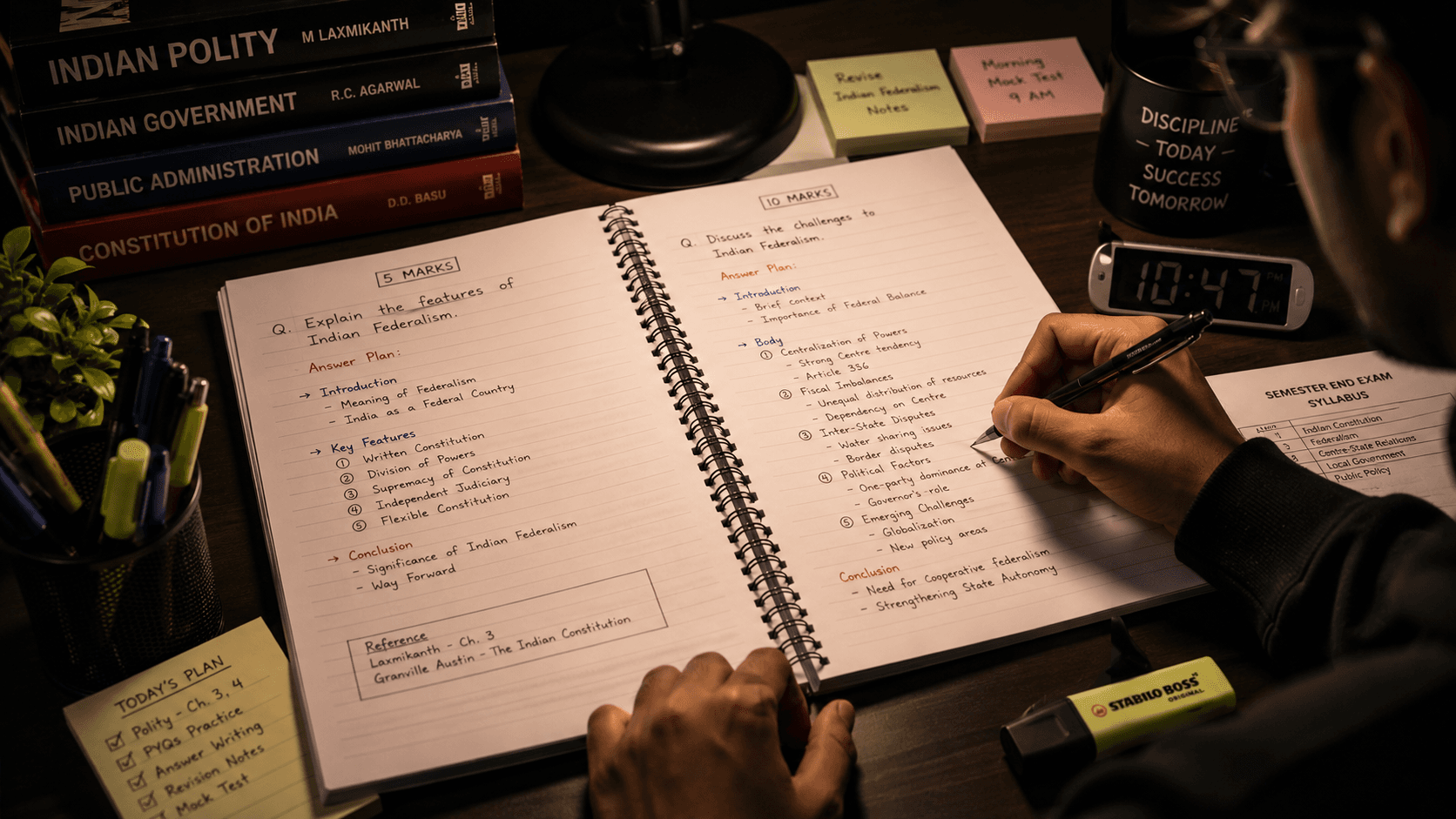
5-Mark vs 10-Mark Questions: How University Students Should Prepare
If you answer 5-mark and 10-mark questions with the same preparation style, you usually lose marks. The answer depth is different, and your revision should reflect that.
Read article